
Most complaints at a magnifying-lamp workstation share one cause: the person adapts to the lamp instead of the other way round. Yet exactly one dimension is genuinely fixed — and once you build outwards from it, the rest almost falls into place.
The working distance is given
A magnifying lamp only shows a sharp image at one particular distance. That distance follows from the dioptre rating and cannot be negotiated:
| Dioptres | Magnification | Lens to workpiece |
|---|---|---|
| 3 | 1.75× | about 33 cm |
| 5 | 2.25× | about 20 cm |
| 8 | 3× | about 12.5 cm |
Everything you can adjust — chair, desk, support, lamp arm — serves to hold that distance without your back stepping in to help.
The order that works
- The chair first. Feet flat on the floor, thighs horizontal. That is the reference for everything else.
- Then the desk. Forearms resting loosely, shoulders down. If the desk is not adjustable, correct through chair height and a footrest.
- Then the workpiece. Upwards — not your head downwards. More on that in a moment.
- The lamp last. The arm brings the lens over the work so you reach the given distance without leaning in.
The most common mistake: the work sits too low
The workpiece lies flat on the desk, the lamp hovers above it, and the head follows downwards. At 8 dioptres, with around 12.5 cm of distance, that inevitably ends in a bent posture.
The fix costs nothing: raise the work instead of lowering your head. A flat block, a box, an angled rest — ten to fifteen centimetres of extra height change the neck angle noticeably. For fine work over hours, it is the single most effective adjustment there is.
Where to put the arm
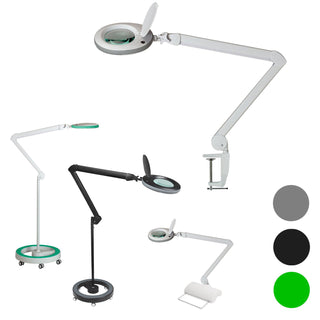
Position the clamp so that the swing covers the whole working area without the arm reaching full stretch at the far end. A sprung arm is steadiest in its middle range; fully extended, any construction tends to bounce. If there is not enough room at the table edge, a rolling stand is the more honest answer than a badly seated clamp — the options are in table clamp, stand or wall bracket.
For any additional lighting beside the magnifying lamp, the old rule holds: it comes from the opposite side to your working hand. Right-handers put the second lamp on the left, or they work in their own shadow.
Do not switch off the room light
A bright lamp in a dark room is more tiring than the same lamp in an evenly lit one, because the eye has to readjust every time you look away from the work. Leave the room light on and keep it similar in colour — why the two are connected is explained in 6,500 kelvin. If a reflection on the lens bothers you, reflections takes it further.
Breaks follow the magnification
The stronger the lens, the narrower the field and the more fixed the gaze. At 8 dioptres, short interruptions every twenty to thirty minutes serve you better than one long break — look up, focus on something distant, carry on.
And if the given distance stays uncomfortable, the cause is usually not the workstation but the lens strength. Which one suits your work is covered in dioptres and magnification.

0 comments