
A metre of reach from two arms
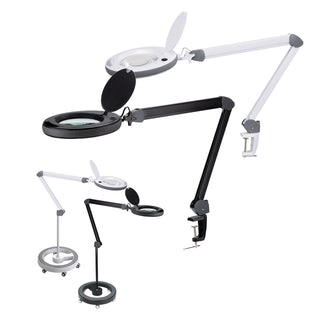
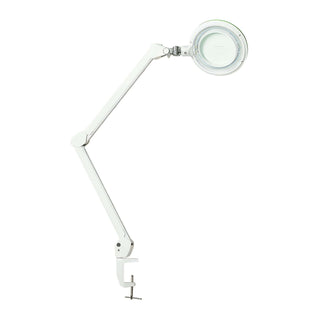
The articulated arm is the component you notice least and use most. On Lumeno magnifying lamps it is built the same way across all series: two arm segments of 420 millimetres each, connected by joints with springs.
From the lower joint to the centre of the lens that gives a reach of around 1,050 millimetres. That is the radius within which you can position the lens freely — a good metre, measured from the clamp or the stand. For planning a workplace, that figure matters more than any height specification.
Why the lamp stays put
A lamp head with a glass lens weighs between two and three kilograms depending on series, far out on the lever. That it nevertheless stays in any position is the work of tension springs in the joints: they pull upwards exactly as hard as gravity pulls down. Once that balance is struck, the arm floats practically weightless — you guide it with two fingers.
The decisive point: this balance is set at the factory to precisely the lens fitted. The springs are matched to its weight, and they can neither be re-tensioned nor replaced.
The arm sinks — what causes it?
This is by far the most frequent feedback on the mechanics, and there are three plausible causes.
A different lens has been fitted
The most common explanation when the sinking began after a modification. A stronger lens is heavier, the spring force stays the same — the result is an arm that slowly gives way. From 3 to 5 dioptres the effect is slight, with bigger jumps it is marked. More on this in the article on changing the lens.
Accessories on the head
Attached supplementary lenses, dust covers or clipped-on holders act at the end of the lever and change the balance noticeably, even though they weigh hardly anything. Take everything off as a test.
Spring force reduced by age
After many years and many thousands of movements, a tension spring weakens. That is normal wear, not a material fault — and unfortunately the case in which nothing can be done at home.
What you can do yourself — and what not
Honestly: not much. On some models the joint screws can be tightened slightly, which increases friction and can compensate for slow sinking. Do not overdo it — a stiff arm is more of a nuisance in daily work than one that gives way a little.
Not recommended: bending, shortening or replacing springs. The springs are under considerable pre-tension; an arm whose spring slips while being dismantled shoots upwards with some force. If the mechanics no longer hold, please write to us instead.
Getting more out of it for longer
- Guide it by the lamp head, not by the arm. Pulling on the arm segment loads the joints sideways — they are not built for that.
- Do not extend it to the stop. In the end position springs and joints work hardest. If the lamp stands permanently fully extended, the position is wrong — move the clamp closer.
- Hang nothing on it. The arm is not a hook for cables, glasses or tools.
- Fold it in for transport. A freely swinging arm on a moving rolling stand is the most common cause of worn joints.
A word on stability
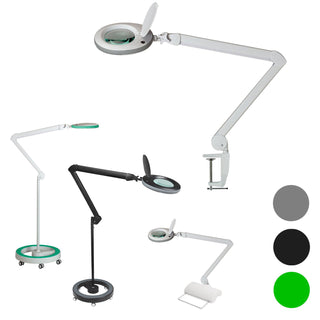
The reach of a good metre has a flip side: fully extended, a considerable tipping moment acts on the mount. On a table clamp or a table stand that is unproblematic, because the desktop supports it. On a rolling stand with a large, heavy lens it can become critical. Which combination is safe we have compiled in the article on mounting.

0 comments